This practice exercise helps students develop skills in syntactically analyzing sentences, identifying their key constituents, and creating hierarchical tree diagrams of such sentences.
Syntaxtrees are used for tasks such as type checking, optimization, and code generation in compilers. They can also be used to represent the structure of other linguistic or logical structures such as natural language sentences or logical expressions.
It is a tree representation of the abstract syntacticstructure of text (often source code) written in a formal language. Each node of the tree denotes a construct occurring in the text. It is sometimes called just a syntaxtree.
One of the homework problems you’ve been assigned requires you to find treestructures that correspond to certain interpretations of an ambiguous sentence. In these notes, I give you a few pointers on how this is to be done.
Drawing a syntaxtree may feel like a confusing and daunting prospect at first glance, but once you understand what you're doing it becomes much easier to handle. This guide will demonstrate how to create a syntax diagram of a simple...
Learn the rules and principles of creating syntaxtree diagrams, an essential tool in analyzing sentence structure and understanding the relationships between words and phrases in a sentence.
A syntaxtree is a tree data structure that records the branching structure of the grammar rules used by the parsing algorithm to check the syntax of an input source file.
Syntactictrees, often called parse trees or constituency trees, are fundamental to understanding how natural language works. They provide a visual, hierarchical representation of the grammatical structure of sentences.
In this section we begin to introduce the formal notation of tree diagrams to represent the structure of phrases and sentences in a way that makes it easier to make specific and testable claims (hypotheses) about them.
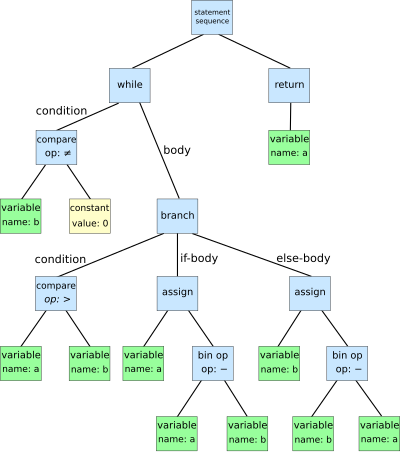 It is a tree representation of the abstract syntactic structure of text (often source code) written in a formal language. Each node of the tree denotes a construct occurring in the text. It is sometimes called just a syntax tree.